Breaking the Take-Make-Dispose Habit and the Rise of the Circular Economy
For roughly two centuries, industrial society has run on a single, unspoken assumption: that we can take raw materials from the earth, make them into products, use those products, and then throw them away. This is the linear economy, often summed up as take-make-dispose, and it has quietly shaped almost everything about how we produce and consume. It is also, increasingly clearly, a model the planet cannot sustain. Extracting ever more resources depletes finite reserves, damages ecosystems, and generates mountains of waste, from the Great Pacific Garbage Patch to overflowing landfills. The circular economy is the emerging alternative, and it represents one of the most important economic ideas of our time: a system designed not to use things up, but to keep them in use.
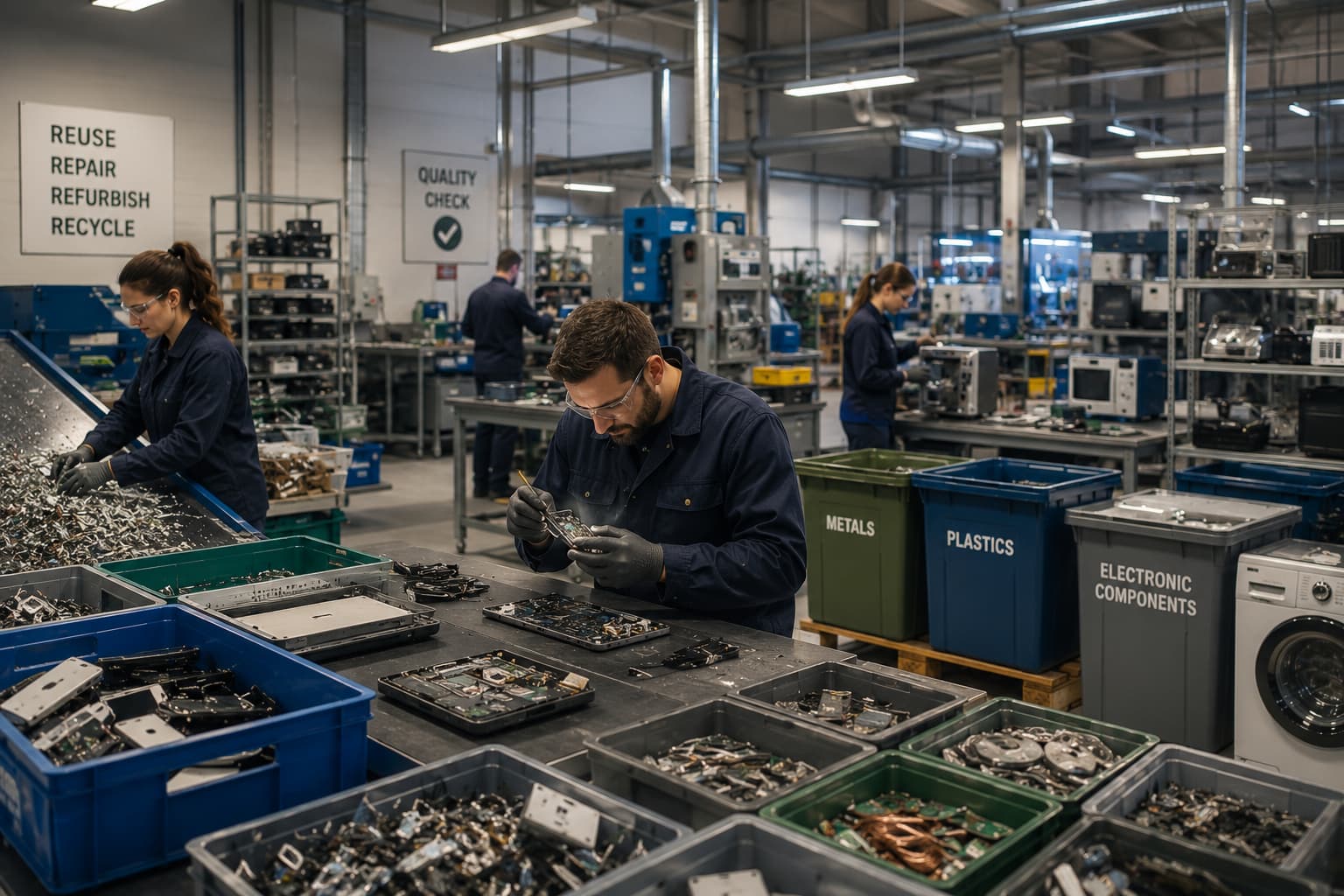
The core principle is a change in how we think about materials. In a linear economy, a product has a beginning and an end, and that end is the bin. In a circular economy, there is no end in the same sense. Products and materials are designed from the very start to circulate, to be maintained, repaired, reused, refurbished, remanufactured, and only as a last resort recycled, so that their value is preserved for as long as possible. Waste, in this vision, is not an inevitable byproduct but a design flaw to be engineered out. Materials are treated as assets to be kept in circulation rather than disposable inputs to be consumed and discarded. It is a shift from an economy of extraction and disposal to one of regeneration and value preservation.
It is worth clearing up a common misunderstanding right away, because the circular economy is frequently confused with recycling. Recycling is part of it, and a valuable one, but it is only the last and least preferred step, a big improvement on simply throwing things away, but far from the whole picture. The real power of circular thinking lies higher up the chain, in reducing how much we consume in the first place, in designing products that last, and in repairing and reusing them so they never need to be broken down at all. Returning a glass bottle to be refilled is more circular than melting it down to make a new one. Keeping a smartphone working for six years instead of two saves far more than recycling it ever could. Recycling recovers some material value; reuse and repair preserve the whole product.
The benefits of getting this right are substantial and go well beyond the environmental. Economically, circular models can decouple business growth from resource consumption, insulating companies from the volatile prices and supply shocks of raw materials, a lesson driven home by recent disruptions to global supply chains. Reducing dependence on imported virgin resources has become a matter of economic security and competitiveness, not just ecology. The circular economy is also more labor-intensive in a good way, because repairing, refurbishing, and remanufacturing are harder to automate than mining and dumping, meaning the transition tends to create jobs. In Europe, the circular economy already employs millions of people, and the shift toward it is projected to add hundreds of thousands more jobs while modestly boosting overall output.
Policy is now driving this transition from voluntary aspiration into enforceable rule, and Europe offers the clearest example. The European Union has made the circular economy a central pillar of its strategy, setting a headline goal of doubling its circularity rate, the share of materials that are recycled or reused rather than thrown away, from around a eighth of all material use to roughly a quarter by the end of the decade. A series of concrete measures now underpins that ambition. Ecodesign rules require products to be made more durable and repairable from the outset. A landmark Right to Repair directive compels manufacturers of everyday goods like washing machines, refrigerators, and smartphones to repair them at a reasonable price, even after the warranty has expired, and extends warranties when a repair is made. Packaging rules mandate minimum recycled content and separate collection targets, and a growing number of countries have introduced deposit return schemes that pay consumers to bring back bottles and cans. A forthcoming framework law aims to tie it all together by creating a genuine single market for recycled, secondary raw materials.
One of the most important tools in this policy kit is extended producer responsibility, the principle that a manufacturer remains responsible for a product even after the consumer is finished with it. By making producers bear the cost of collecting and processing what they put on the market, this approach flips the incentives, rewarding companies that design for durability and recyclability and penalizing those that flood the market with disposable, hard-to-recycle goods. Alongside it, digital tools that track a product’s materials through its whole life are becoming foundational, letting regulators, companies, and consumers verify sustainability claims and trace where materials actually go.
None of this is easy, and honesty about the obstacles matters. Progress has been slow, and the gap between ambition and reality is wide, with real circularity rates stubbornly stuck well below their targets. A core difficulty is economic: recycled materials are often more expensive, or perceived as lower quality, than freshly extracted virgin ones, which undermines demand for them. For the circular economy to work at scale, using recycled content has to become genuinely cheaper and easier than not doing so, which requires both regulation and innovation. And it is worth being realistic that a perfectly closed loop, with zero waste and no new materials at all, is essentially impossible; the practical goal is to squeeze as much waste out of the system as we can, not to achieve a mythical perfect circle.
Even with those caveats, the direction is unmistakable and the logic is compelling. A world of finite resources and rising consumption cannot indefinitely sustain a throw-away model. The circular economy offers a way to keep economies growing and people prospering while dramatically reducing the strain on the natural world, by treating the things we make as too valuable to waste. It asks a deceptively simple question that upends two hundred years of habit: what if nothing we made was ever meant to be thrown away?